What Is Crawl Space Encapsulation? A Plain-English Guide
What is crawl space encapsulation? It is a moisture-control project that seals your crawl space with a thick plastic liner, closes the vents and adds humidity control, so damp ground air stops rising into your home. This guide explains each part, what it is made of and when it makes sense.
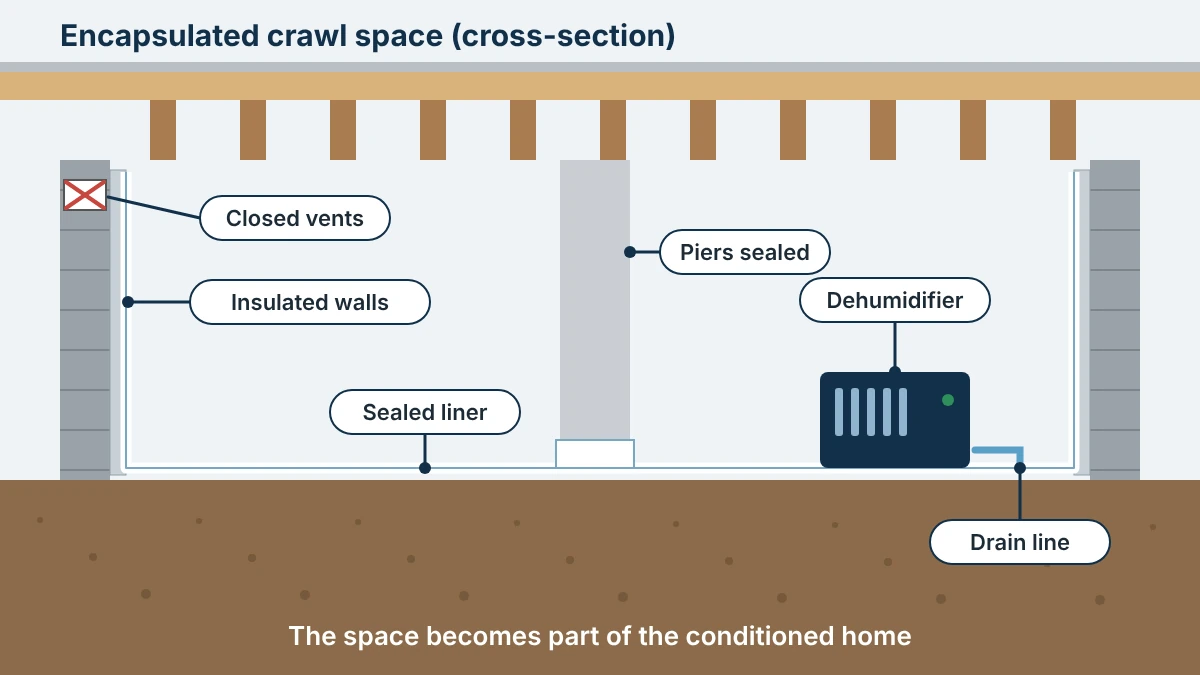
The problem encapsulation solves
A crawl space is the shallow gap between the ground and your first floor. Soil releases moisture constantly, and in warm, humid regions vented crawl spaces also take in humid outdoor air. When that air meets cooler surfaces it condenses. Over months, wood absorbs water, insulation sags, mold grows and musty air moves upward, because warm houses naturally pull air from below, a process known as the stack effect.
This is not just theory. A paper in the journal Reviews on Environmental Health examined crawl spaces as reservoirs for the transmission of mold to the living area of the home. The EPA also says the best way to control mold growth is to control moisture.
The five parts of a standard job
- Ground linerA reinforced polyethylene vapor barrier is laid over the whole dirt floor with overlapping, taped seams.
- Wall linerThe barrier is run up the foundation walls and fastened, so moisture cannot enter through masonry.
- Vent sealingFoundation vents are blocked and rim joist gaps are sealed to stop outside air from entering.
- DrainageIf water collects, a drain line and sump pump carry it out so the liner is not sitting in a pond.
- Humidity controlA dehumidifier or conditioned supply air holds humidity at a safe level all year.
Materials you will hear about
Liners are usually rated by thickness in mils, where one mil is one thousandth of an inch. Basic barriers start around 6 mil, while reinforced, multi-layer liners of 10 to 20 mil are common in full jobs because they handle foot traffic better. Ask the contractor for the product name and warranty, not just the thickness. Tapes, wall fasteners and closed-cell foam for rim joists are other typical components.
Encapsulation versus a plain vapor barrier
A loose sheet of plastic on the ground is not encapsulation. It slows soil moisture but leaves vents open and walls untreated, so humid air still enters. Encapsulation deals with the whole space: ground, walls, air and humidity. It costs more than a sheet of plastic, and it works better in damp climates for the same reason.
What is crawl space encapsulation best used for?
Encapsulation is most useful when you have a vented crawl space in a humid region, signs of moisture or mold, or a goal of improving indoor air and comfort. It is less urgent for a crawl space that is dry year round. Building codes differ by area, and the International Residential Code addresses unvented crawl spaces, so check local rules through your contractor or ICC code resources.
What to expect afterwards
The space should look clean, bright and sealed. Many homeowners notice less odor and more even floor temperatures. You will still need to maintain the dehumidifier, keep the drain clear and avoid puncturing the liner when storing things. Look in once a year.
Talk to a local crawl space pro
Call now to describe your crawl space and get a free, no-obligation estimate from an independent local contractor.
Free estimate. No obligation.
Why crawl space air reaches your living room
Warm air rises through a house and escapes near the top, which pulls replacement air in at the bottom. Building scientists call this the stack effect, and it means damp, musty crawl space air can travel up through gaps around pipes, ducts and the subfloor into the rooms above. That is why a crawl space problem often shows up as odors, allergy symptoms or cold floors upstairs. Moisture also feeds wood rot in joists and the subfloor, attracts termites and other pests, and soil gas can carry radon into a home. A liner is not a radon system, so test your home using the EPA radon guidance. Sealing the ground and walls cuts the moisture supply at the source, which is why encapsulation is paired with air sealing.
Frequently asked questions
Is encapsulation the same as waterproofing?
No. Waterproofing manages liquid water with drains, sump pumps and grading, while encapsulation controls vapor and air with a liner, sealed vents and humidity control. Many jobs include both, and a wet crawl space often needs drainage before a liner goes in.
Does a sealed crawl space need a dehumidifier?
Usually yes, because moisture still enters through the soil and the house even after sealing. A crawl-space-rated dehumidifier keeps humidity in a healthy range and protects the wood. Ask your contractor whether one is included and how it is sized for your space.
Can encapsulation cause problems?
Done poorly, yes. A badly sealed liner can trap moisture, cover mold or ignore combustion air for gas appliances. That is why proper design, a qualified installer and a written scope matter, and why existing mold, rot or standing water should be handled before sealing.
How much does it cost?
It depends on size and condition. Published guides cite an average near $5,500 with a wide range, and drainage, repairs and dehumidifiers change the total. See our price guide for ranges and what drives a quote, then compare written estimates.
Crawl Space Saver is a free referral service. We are not a contractor. We connect homeowners with independent local crawl space professionals, who set their own prices and do the work.