When NOT to Encapsulate a Crawl Space: 6 Honest Checks
Not every crawl space should be sealed. Encapsulation works well on a damp, vented crawl space in a humid state, but it can make things worse if the space has standing water, sits where flood vents are required, holds an older gas furnace or water heater, or has a termite or rot problem nobody has dealt with yet. Here are the six situations where you should stop, fix something first or do it a different way.
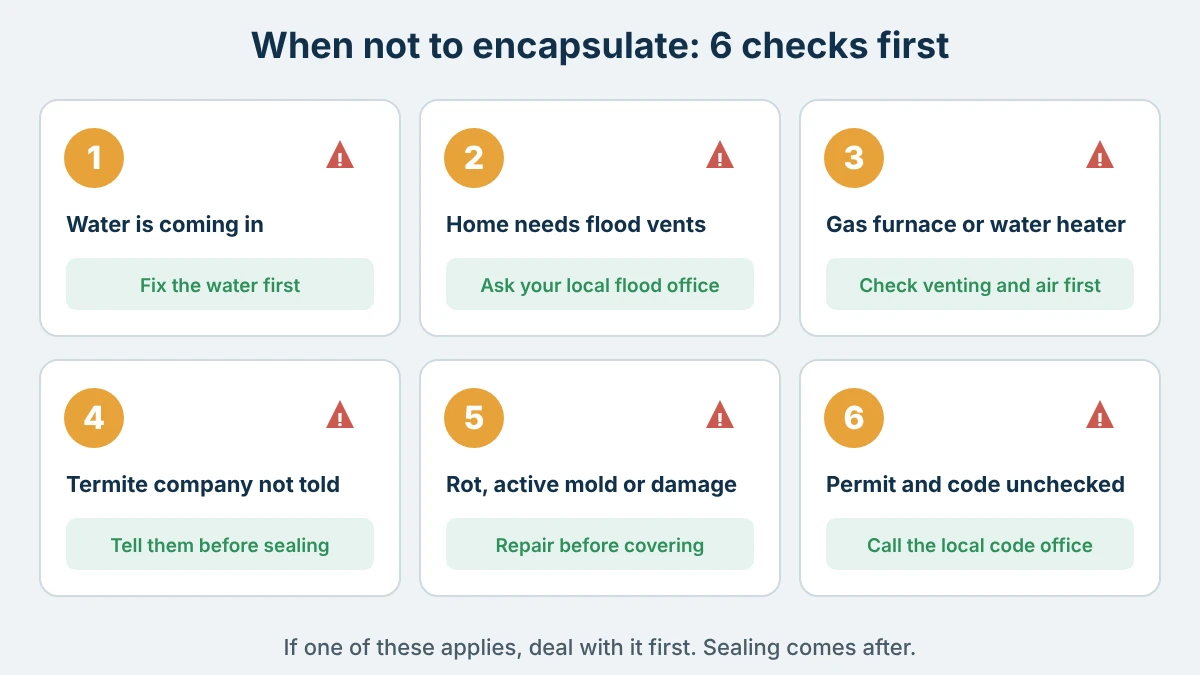
1. Water is coming in
A liner stops moisture rising out of the soil. It does not stop water running in from outside. If the floor is wet after rain, if you see a water line on the walls, or if a downspout dumps at the foundation, fix that first. Energy Vanguard, a building science firm, says covering bulk water with plastic may be worse than doing nothing, and Green Building Advisor says the same in its own guide. Common causes are bad grading, short or broken downspouts and a yard that slopes toward the house. A good contractor will price drainage, a sump or a grading fix before the liner, not after.
2. Your home needs flood vents
If your crawl space sits in a mapped flood zone, the code may require openings that let floodwater flow in and out so the walls do not take the full pressure. One summary of FEMA’s flood opening rules lists at least two openings, about one square inch of opening for every square foot of enclosed floor, and openings within one foot of the ground. Ordinary crawl space vents usually do not count unless they are permanently open. Sealing those openings can break the rule and can leave you with a sealed box that holds floodwater. Both Energy Vanguard and Green Building Advisor say not to encapsulate where flood vents are required.
Parts of coastal Virginia and eastern North Carolina have a lot of mapped flood zones, so check yours on the FEMA Flood Map Service Center and ask your city or county floodplain office before you close anything. Your insurance agent should hear about it too.
3. A gas furnace or water heater lives down there
Older gas appliances pull the air they burn from the room around them. Seal the crawl space and that air can run short, which can cause poor combustion, backdrafting and carbon monoxide. Advanced Energy’s guide to closed crawl spaces for the Southeast says natural-draft appliances should not go in a closed crawl space, that sealed-combustion (direct-vent) units are the answer, and that passive combustion air openings do not work under the North Carolina Mechanical Code because they defeat the air sealing.
Energy Vanguard gives one rule of thumb from the 2018 code: at least 50 cubic feet of space for every 1,000 BTU per hour of heating capacity. An 80,000 BTU furnace would need about 4,000 cubic feet. Many crawl spaces are smaller than that. The fixes are a direct-vent unit, a heat pump or moving the appliance. Have a qualified HVAC or gas pro look before sealing, and put carbon monoxide alarms in the living space either way.
4. Nobody has told the termite company
A liner or foam over the wall can hide the places a termite inspector needs to see. Some pest control companies cancel or limit a termite contract when the work was done without them. Call yours first, ask what they need, and get the answer in writing. We cover this in detail in our post on encapsulation and termites.
5. There is rot, active mold or damaged framing
Sealing locks in whatever is already there. Soft joists, a sagging subfloor, black growth or wet insulation need cleaning, repair or removal first, otherwise you are covering a problem you paid to find. Start with our guide to crawl space mold, and if the wood is soft ask a contractor or an inspector how much needs replacing.
6. Nobody has checked the permit and code
Rules differ by state and often by town. In North Carolina, the Office of State Fire Marshal said in a December 2025 interpretation that turning a vented crawl space into a closed one needs a permit regardless of cost, because every moisture control option adds equipment or changes the system. North Carolina numbers that section R409 in its residential code. Tennessee and Virginia codes vary by locality, so call your local code office and ask whether a permit or plan review applies.
For a sense of what a sealed crawl space has to include, Knox County, Tennessee, publishes an under-floor guide that follows the International Residential Code:
| Item | What the guide says |
|---|---|
| Vented crawl space | 1 sq ft of vent per 150 sq ft of floor, or 1 per 1,500 with an approved ground vapor retarder |
| Ground cover | Continuous, seams overlapped 6 inches and sealed, up the wall at least 6 inches |
| Unvented crawl space | Needs plan approval |
| Moisture control for unvented | One of: exhaust fan, conditioned air supply, plenum, or a dehumidifier sized at 70 pints a day per 1,000 sq ft |
| Walls | Perimeter walls insulated for the fan and supply options |
That is one county, and the edition of the code it cites is not stated, so treat it as an example and confirm with your own office.
What to do instead
If your crawl space fails one of these checks, you still have choices. Fix the water. Add a ground cover to the vented space, which the Knox guide lets you pair with fewer vents. Insulate and air seal the floor above, which is what Energy Vanguard suggests when encapsulation does not fit. Replace an old appliance with a sealed-combustion unit and then revisit sealing. See our guides to the vapor barrier and insulation.
When sealing is still the right call
If the space is damp and vented, drains well, has no flood vent rule, no natural-draft appliance and no rot, and your termite company is on board, encapsulation is often a sound answer in Tennessee, the Carolinas and Virginia. Our page on whether it is worth it walks through the other side of the decision.
Not sure which side you are on?
Call and describe your crawl space. An independent local pro can tell you whether sealing fits or whether something needs fixing first.
Free estimate. No obligation.
Frequently asked questions
Can I encapsulate if I have a sump pump?
Often yes. A sump or interior drain is one way contractors give water somewhere to go before the liner goes in. What matters is that water has a path out and that the pump has power and a way to be checked, so ask where the pump discharges and how you will know if it fails.
Will sealing my crawl space hurt my gas furnace?
It can if the furnace is a natural-draft model that draws air from the crawl space. Direct-vent (sealed combustion) units bring in outside air through a pipe and are the safe fit. Have a qualified pro check the appliance before any sealing.
Do I need a permit to encapsulate a crawl space?
In North Carolina, the State Fire Marshal’s office says converting to a closed crawl space needs a permit regardless of cost. Tennessee and Virginia rules vary by locality and by scope, so call the building department before you start.
Is a vented crawl space ever fine?
Yes. Vented crawl spaces can work in dry climates. In the humid Southeast, warm outside air can condense on cool surfaces in summer, so vented spaces tend to stay damp, but a ground cover and floor insulation may be enough for some homes. A local inspection tells you which case you have.
Talk to a local crawl space pro
Call now to describe your crawl space and get a free, no-obligation estimate from an independent local contractor.
Free estimate. No obligation.
Crawl Space Saver is a free referral service. We are not a contractor. We connect homeowners with independent local crawl space professionals, who set their own prices and do the work.